

WHERE THE MONEY GOES
Understanding the Fee Structure and Distribution Process
This page explains, in simple terms, how the fee structure works based on the actual contract documents received in an email received from Mark Meersman on September 15, 2015. All personal information on this contract has been redacted to protect the member who donated the document.
This page focuses on explaining the structure of the contract, not making conclusions. Readers are encouraged to review the documents and form their own understanding.
To make it easy to understand, we use a $1,000,000 example.
This is only for illustration, but the percentages and structure come directly from the contract.
Contract Fee Structure
Key Contract Sections
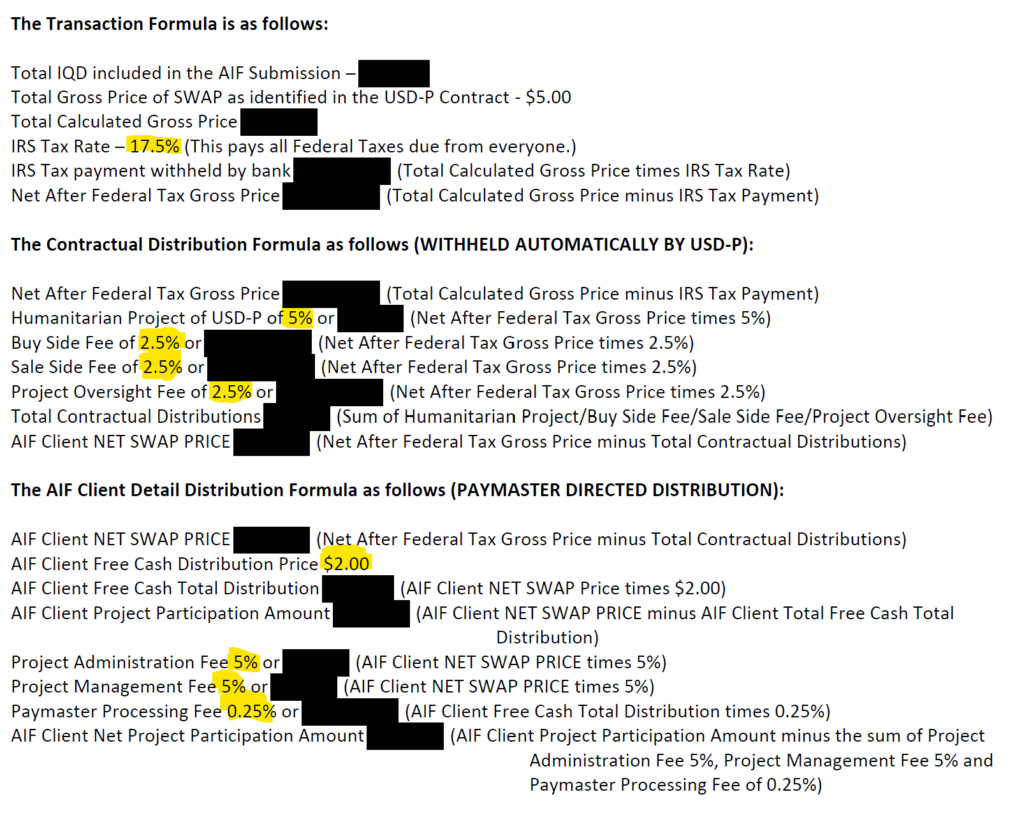
Contract excerpt (Page 1) showing initial calculation, tax deduction, and first stage of fees. Personal and identifying information has been removed.
This page shows:
- How the total amount is calculated
- The first set of deductions
- How the remaining money is divided
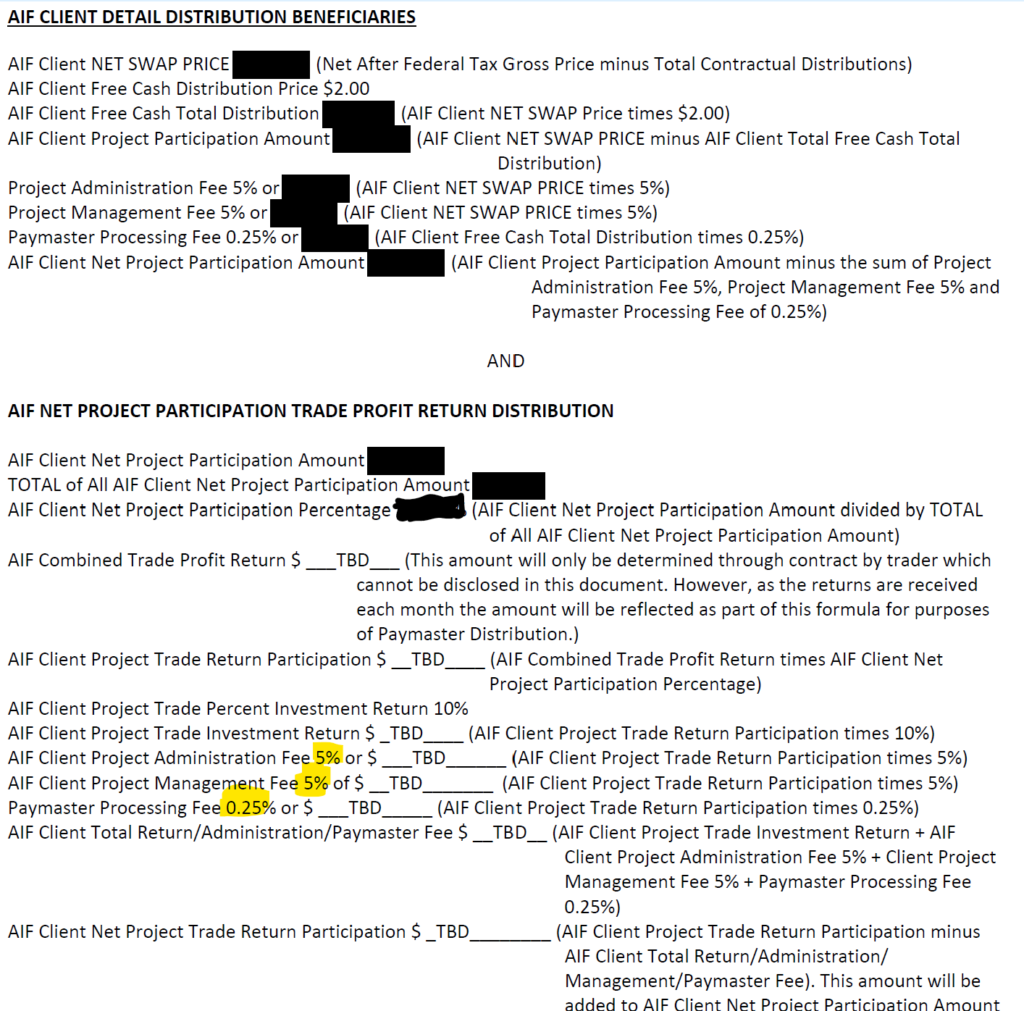
Contract excerpt (Page 5) showing additional fees applied to the remaining project portion.
This page shows:
- That fees are taken again later
- Additional deductions from the remaining portion of funds
What This Means in Simple Terms
This is not a one-time fee. Instead:
- Money is reduced in multiple steps
- Fees are taken at different stages
- Not all funds are paid directly to the participant
- Some funds may stay in a project or program
Example Using $1,000,000
The example below shows how this structure works using
Step 1: Taxes Are Taken First
Starting amount:
➡️ $1,000,000
The contract shows a 17.5% tax deduction.
- Tax taken: $175,000
- Remaining: $825,000
Simple explanation:
Before anything else happens, a large portion is removed for taxes.
Step 2: First Group of Fees
Next, several fees are taken from what remains:
- 5% Humanitarian Fee
- 2.5% Buy Fee
- 2.5% Sell Fee
- 2.5% Oversight Fee
Total: 12.5%
- Fees taken: $103,125
- Remaining: $721,875
Simple explanation:
After taxes, more fees are taken right away, reducing the amount further.
Step 3: The Money Is Split
The remaining $721,875 is then divided into two parts:
- Cash portion (example): $400,000
- Project portion: $321,875
Simple explanation:
Not all of the remaining money is paid directly to you.
Part may be placed into a project instead.
Step 4: More Fees Are Taken Again
The contract shows that additional fees are taken later, especially from the project portion:
- 5% Administration Fee
- 5% Management Fee
- 0.25% Paymaster Fee
Example:
- Fees taken: about $33,000
- Remaining project amount: about $288,000
Simple explanation:
Even after the split, more fees are taken, reducing the amount again.
Simple Breakdown
| Stage | Amount |
|---|---|
| Starting amount | $1,000,000 |
| After 17.5% tax | $825,000 |
| After first fees | $721,875 |
| Example cash portion | $400,000 = What you get up front |
| Project portion before more fees taken | $321,875 = Assigned to projects |
| Project portion after additional fees | ~$288,000 = Actual amount for projects |
What This Shows
- Fees are taken more than once
- Money is reduced in stages
- Different fees apply to different parts of the total
- Not all funds are paid directly to the participant
- Additional deductions can happen later in the process
Key Takeaway
From a $1,000,000 example, more than $300,000 may be deducted through taxes and fees before the process is complete.
In addition, not all remaining funds may be paid directly, as a portion may stay in the program and be subject to further deductions.
*Important Note*
This example is for educational purposes only.
- It uses a simplified amount to explain the structure
- The percentages come directly from the contract
- Actual results depend on how the contract is applied in practice